
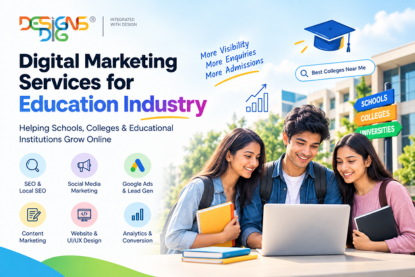
Digital marketing services for education industry have become essential for schools, colleges, universities, coaching institutes and other educational organizations that want to reach students and parents online. Today, prospective students do much of their research before making an admission enquiry. They search Google, compare institutions, explore courses, check placements, read reviews, watch videos and visit websites before taking the next step.
For educational institutions, this means having a website alone is not enough. A strong digital presence requires SEO, content marketing, social media, Google Ads, website optimization, branding, local SEO, AEO, GEO and SXO working together.
Designsdig, a creative agency in Hyderabad, combines branding, digital marketing, website development, UI/UX, SEO, social media and creative services to help organizations build a connected digital presence.
Whether an institution needs digital marketing services for schools, digital marketing services for colleges, or a broader education marketing strategy, the focus should be on reaching the right audience with useful information at the right stage of the admission journey.
The way students and parents discover educational institutions has changed significantly.
A parent searching for a school may use Google to find:
Similarly, a student looking for higher education may search:
These searches represent different types of search intent.
An educational institution therefore needs more than one keyword or one landing page. It needs a complete digital ecosystem that answers questions throughout the student’s decision-making process.
A useful education marketing journey can look like this:
Google Search → Website → Course Information → Comparison → Enquiry → Campus Visit → Application → Admission
Digital marketing helps an institution participate in each of these stages.
Digital marketing services for the education industry are online marketing activities designed around the requirements of schools, colleges, universities, educational institutes and other organizations in the education sector.
These services can include:
The right combination depends on the institution, target audience, location, courses, competition and admission objectives.
For example, a school may require strong local SEO and parent-focused content, while an engineering college may need course SEO, placement content, Google Ads and student-focused social media campaigns.
Digital marketing services for schools should focus on building visibility among parents and communicating the school’s academic environment, facilities, achievements and overall educational experience.
Parents often conduct detailed online research before contacting a school.
They may want to know:
A school’s digital marketing strategy should therefore make this information easy to discover.
SEO can help schools appear for relevant searches made by parents.
A school SEO strategy may include:
For example, instead of creating a page containing only the phrase “best school in Hyderabad,” a school can create useful content explaining its curriculum, facilities, teaching approach, activities, admission process and location.
This provides value to parents while giving search engines clearer information about the institution.
Social media can help schools demonstrate what happens on campus.
Content opportunities include:
Visual content can give prospective parents a better understanding of the school’s environment.
The goal should be to communicate genuine experiences rather than simply publish promotional messages.
Digital marketing services for colleges require a broader student-focused strategy because prospective college students frequently compare several institutions before making an admission decision.
Students may compare:
A college website can build content around different stages of search intent.
Examples:
Examples:
Examples:
Examples:
Creating content for these different search intents allows a college to build a stronger topical presence rather than relying on one generic admissions page.
Content marketing is one of the most important parts of education digital marketing.
Students and parents have questions before they become leads.
A college can publish articles such as:
A school can create content such as:
This type of content can attract users earlier in their decision journey.
It also gives an institution opportunities to demonstrate its knowledge and provide useful information rather than relying exclusively on promotional pages.
SEO should be at the center of a long-term education marketing strategy.
A comprehensive education SEO strategy can include:
Students increasingly search using complete questions.
Instead of typing:
“engineering colleges Hyderabad”
a student might ask:
“What should I consider before choosing an engineering college in Hyderabad?”
This is where Answer Engine Optimization (AEO) becomes useful.
An AEO-friendly education page can use:
For example:
Students can compare the course curriculum, accreditation, faculty, infrastructure, placement information, location, fees, campus facilities and career opportunities before making an informed decision.
The answer is useful even before the reader becomes an admission lead.
That is an important principle of modern search optimization: answer the user’s question first and optimize the page around that genuine information need.
Search is also expanding beyond traditional blue-link results.
Students may use AI-powered search tools to ask questions about:
This has increased interest in Generative Engine Optimization (GEO).
For educational institutions, GEO should not be treated as a collection of tricks for forcing an AI system to mention a brand.
Instead, institutions should make their information clear, accurate and easy to understand.
Important information includes:
Google’s current search guidance continues to emphasize useful, original content and established SEO fundamentals rather than artificial methods designed to manipulate search systems.
SEO can bring a prospective student to an institution’s website.
But what happens after the click?
Consider this journey:
Student searches → Finds college → Clicks website → Cannot find course information → Leaves
The institution may have received the search impression and click but lost the potential enquiry.
This is why Search Experience Optimization (SXO) is important.
SXO connects:
Search Intent + SEO + Content + UX + Website Performance + Conversion
An education website should provide:
Designsdig combines digital marketing with UI/UX and website development, allowing these areas to be considered together.
SEO is a long-term acquisition channel, while Google Ads can provide immediate visibility for specific campaigns.
Educational institutions can use Google Ads for:
A campaign should connect the complete journey:
Keyword → Advertisement → Landing Page → Enquiry → Follow-up
Tracking should go beyond clicks.
Institutions should monitor metrics such as:
College students are highly visual audiences, making social media and video valuable components of education marketing.
Colleges can create:
Social media can show aspects of campus life that are difficult to communicate through static website pages.
However, institutions should ensure that their content accurately represents their campus, facilities and student experience.
Local SEO is particularly important for schools and colleges that attract students from specific geographic areas.
An educational institution should maintain accurate information such as:
Local searches may include:
Location-specific content should be genuinely useful rather than creating large numbers of almost identical pages.
Google’s spam policies specifically warn against doorway pages created primarily to rank for similar search queries.
Education is a trust-sensitive industry.
Students and parents want reliable information before making an important decision.
Educational websites can strengthen trust by clearly presenting:
If an institution publishes placement statistics, rankings, package figures or achievement claims, the information should be accurate and appropriately explained.
Digital marketing should make trustworthy information easier to discover—not replace the need for trustworthy information.
when explaining how an education brand can combine SEO, branding, website development and social media, readers can naturally be directed to Designsdig’s detailed article about Top Digital Marketing Agency in Hyderabad. That article discusses how branding, SEO, website development, UI/UX and digital marketing can work together.
Similarly, when discussing the importance of selecting the right digital marketing partner for an educational institution, readers can explore Top 10 Digital Marketing Companies in Hyderabad, which examines digital marketing capabilities, SEO, performance marketing, branding, website development and user experience.
The AI-search section of this article can also naturally lead readers to Best AI Digital Marketing Companies in Hyderabad, particularly when discussing AEO, GEO, AI-powered search, SEO and SXO.
Designsdig is a creative agency that combines marketing, branding, design, website development and digital services.
Its publicly presented capabilities include:
This integrated model can be useful for educational institutions because the website, branding and marketing campaigns should communicate a consistent message.
For example:
SEO brings relevant visitors.
Content answers their questions.
Website UX helps them find information.
Branding creates recognition.
Social media communicates campus activity.
Google Ads can support admission campaigns.
Analytics helps measure the journey.
Designsdig’s existing digital marketing work also covers education among the sectors discussed on its website.
Start by understanding:
Identify what students and parents actually search for.
Group the searches into:
Build clear pages for:
For an engineering college, for example:
Engineering Colleges
→ Engineering courses
→ CSE colleges
→ AI & ML colleges
→ Data science colleges
→ Cybersecurity courses
→ Engineering placements
→ Engineering admissions
This creates a connected content structure.
Develop content around actual student and parent questions.
Avoid publishing large quantities of generic articles simply because keywords exist.
Ensure:
Monitor:
Educational institutions need a digital marketing partner that understands both creative communication and search visibility.
Designsdig brings together:
SEO + Digital Marketing + Branding + Social Media + Website Development + UI/UX + Content + Creative Design
This allows an education brand to build a consistent presence across:
The agency’s own digital marketing resources discuss the relationship between SEO, branding, UI/UX, website development, AEO, GEO and SXO.
For an institution searching for digital marketing services for schools or digital marketing services for colleges, this integrated approach can be adapted according to its audience and objectives.
Although both require digital marketing, their audiences and search journeys can be different.
| Area | Schools | Colleges |
|---|---|---|
| Primary audience | Parents and students | Students and parents |
| Local SEO | Highly important | Important |
| Admissions | Parent-focused | Student-focused |
| Content | Curriculum, activities, safety, facilities | Courses, placements, careers, infrastructure |
| Social media | Events and student activities | Campus life, placements and student experiences |
| SEO topics | Schools, curriculum, admissions | Courses, colleges, placements |
| Lead generation | Admission enquiries | Course and admission enquiries |
| Video | Campus and activities | Campus, departments and student life |
The strategy should therefore be customized rather than using exactly the same marketing plan for every educational institution.
Digital marketing services for the education industry include SEO, local SEO, Google Ads, social media marketing, content marketing, website development, UI/UX, video marketing, lead generation, analytics, AEO and GEO strategies designed around educational institutions.
Digital marketing services for schools include school SEO, local SEO, Google Business Profile optimization, social media marketing, content creation, Google Ads, website optimization and admission lead generation.
Digital marketing services for colleges include SEO, course-focused content marketing, Google Ads, social media, website optimization, placement-focused content, admission campaigns, lead generation and conversion tracking.
SEO can help students and parents discover an institution when they search for schools, colleges, courses, admissions, placements and related educational information.
Schools can combine local SEO, useful content, social media, Google Ads, website optimization, video content and conversion-focused enquiry options to attract relevant prospective parents and students.
Colleges can target course-related, admission-related and location-based searches through SEO and paid campaigns. Dedicated landing pages, enquiry forms, phone tracking and WhatsApp can then help capture enquiries.
Yes. Social media can help colleges showcase student achievements, campus activities, placements, events, departments, facilities and student experiences.
AEO, or Answer Engine Optimization, focuses on creating clear and structured answers to questions that users ask through search and answer-oriented platforms.
GEO, or Generative Engine Optimization, generally refers to strategies aimed at improving the visibility and understanding of a brand’s information within generative AI search experiences.
SXO stands for Search Experience Optimization. It combines search visibility with website usability, content clarity, page experience and conversion paths.
There is no universal timeline. Results depend on the website’s existing authority, competition, technical condition, content quality, search intent and the amount of ongoing optimization.
No legitimate SEO strategy can guarantee a particular Google ranking position. Google’s systems determine rankings, and its policies specifically prohibit tactics intended to manipulate search rankings.

At DesignsDig, we are deeply committed to safeguarding the privacy and security of our clients, visitors, and users. Our Privacy Policy outlines how we collect, use, and protect your information, ensuring transparency and compliance with global privacy standards. Whether you’re engaging with us for UI/UX services, Front-End Development, Back-End Development, Web Applications, Customized ERP solutions, Digital Marketing, WordPress Development, Ecommerce, or Branding services, your privacy is paramount.
We collect various types of information to provide and improve our services:
Personal Information
When you engage with our services, we may collect personal information such as your name, email address, phone number, and payment details. This information is necessary for communication, billing, and fulfilling our contractual obligations.
Non-Personal Information
We also collect non-personal information such as browser type, IP address, and website usage patterns. This data helps us analyze and enhance user experience and ensure the security of our website.
Cookies and Tracking Technologies
Our website uses cookies and other tracking technologies to personalize your experience, track your movements on our site, and gather demographic information. You can control cookie usage through your browser settings.
We use the information we collect in several ways:
To Provide Services
Your information is essential for delivering our wide range of services, from UI/UX design to Digital Marketing. We use your data to communicate with you, process payments, and ensure that our services meet your expectations.
To Improve Our Website
The non-personal information we collect allows us to understand how visitors interact with our website, enabling us to make informed decisions on website improvements and content strategy.
For Marketing Purposes
With your consent, we may use your personal information to send you updates, newsletters, and promotional materials related to our services. You can opt out of these communications at any time.
To Comply with Legal Obligations
We may use your information to comply with applicable laws, regulations, and legal processes.
We respect your privacy and will never sell your personal information to third parties. However, there are instances where we may share your information:
With Service Providers
We may share your information with trusted third-party service providers who assist us in delivering our services. These providers are bound by confidentiality agreements and are prohibited from using your information for any other purpose.
For Legal Reasons
We may disclose your information if required to do so by law or in response to valid requests by public authorities (e.g., a court or a government agency).
We implement robust security measures to protect your personal information from unauthorized access, alteration, disclosure, or destruction. Our security practices are regularly reviewed and updated to ensure the highest level of protection.
You have the following rights concerning your personal information:
Access
You have the right to request a copy of the personal information we hold about you.
Correction
If your information is inaccurate or incomplete, you have the right to request corrections.
Deletion
You can request the deletion of your personal information under certain conditions.
Restriction
You have the right to request that we restrict the processing of your personal information.
Data Portability
You have the right to request that your personal information be transferred to another organization, or directly to you, under certain conditions.
As a global company, we may transfer your information to countries outside of your own for processing and storage. We ensure that all international transfers comply with applicable data protection laws and are protected by appropriate safeguards.
We retain your personal information only for as long as necessary to fulfill the purposes for which it was collected and to comply with legal and regulatory requirements. When your information is no longer needed, we securely delete or anonymize it.
Our website may contain links to third-party sites. Please note that we are not responsible for the privacy practices of these sites. We encourage you to review the privacy policies of any third-party websites you visit.
We may update this Privacy Policy from time to time. Any changes will be posted on this page with an updated revision date. We encourage you to review this policy periodically to stay informed about how we are protecting your information.
If you have any questions or concerns about this Privacy Policy or our data practices, please contact us at:
DesignsDig
designsdig@gmail.com
6302175327